Rank the google maps top 5 for your money keywords, guaranteed
http://www.str8-creative.io/product/1500-gmaps-citations/
regards,
Str8 Creative
Epic Imperial Guard Baneblades
Not painting much these days what with the heat, but I did finish tidying up the base colors recently.

I was getting tired with the lack of perceived progress while painting the entire army though, so switched gears and just started painting the Baneblades. They just need a clear coat and flock at this point. Onto to something else next week.


Choices And Compromises
"You pays your money and takes your choice".
My inner "realist" is protesting but my "practical" hat is on, allowing me to override objections despite the danger of edging the whole thing closer to "just a game".
Now to add the rest of the terrain and the Red army.
I had a very wise and well informed prof who made good use of that expression when young officer cadets used to press him for the definite "right" answer to various historical questions such as "which side was in the right?".
Well, if you are going to play with big figures on a small table, and abide by a choice that every collection provide a different sort of game, you have to get used to making choices, choices that sometimes go against the expectations formed by decades of miniature historical wargaming.
 |
| Testing the fit for Bridgehead Breakout on a small table with small units of 54's. |
This is the sort of scenario where I tend to picture the units as battalions or even brigades of troops but my 54mm games are supposed to fighting small battles such as those fought during the Fenian Raids where a whole "army" is only as strong as a paper strength battalion or maybe two. Theoretically this should mean longer ranges but since I've chosen to play on a small table, I am going to have to shorten the ranges again, even if it the unit frontage vs range makes units feel more like battalions or else like musket armed troops. If not the sides will be able to fight it out without and need to manouver.
 |
| A variation on the scenario played a few years ago with 18 figure, 1/72nd regiments, the way my mind sees a "real" wargame. . |
Now to add the rest of the terrain and the Red army.
Domain Authority 50 for your website - Guaranteed Service
We`ll get your website to have Domain Authority 50 or we`ll refund you every
cent
for only 150 usd, you`ll have DA50 for your website, guaranteed
Order it today:
http://www.str8-creative.co/product/moz-da-seo-plan/
thanks
Alex Peters
cent
for only 150 usd, you`ll have DA50 for your website, guaranteed
Order it today:
http://www.str8-creative.co/product/moz-da-seo-plan/
thanks
Alex Peters
The 7 Habits Of Highly Effective People, Part II Summary
HABIT 4: THINK WIN/WIN
In general, the best approach is Win/Win as it seeks mutual benefit in all human interactions. It sees life as cooperative, not competitive. Whole books are dedicated on how to achieve Win/Win in actionable steps, demonstrating the powerful impact of this book.
However, Covey takes a more fundamental approach, so you can apply it to all areas instead of a formulaic, simplistic way. He notes that character is the foundation of Win/Win, and we need three character traits to achieve this.
Trait One: Integrity. You need Habits 1 to 3 to develop and maintain integrity. When we identify our values and what we want, we can go for the Win. You can't go for the Win if you don't know what your goals and principles are, because what are you fighting for in the first place?
Trait Two: Maturity. This is the balance between courage and consideration. You need to be very courageous because you must show your vulnerability as you discuss your needs and wants openly and honestly. This must be balanced with consideration of the other person's needs and wants. Maturity validates BOTH you and the other person as important. This also boils down in self-compassion principles where you honor yourself as much as others.
Trait Three: Abundance Mentality. Covey was the one who coined the term Abundance Mentality, as well as Scarcity Mentality. The concept of Abundance has also led to tons of books written on the subject.
When you have Abundance Mentality, you recognize that there's enough in the world for both parties to succeed. Your success does not have to take away from another's success.
With an Abundance Mentality, you realize that there is plenty out there to go around so you can share prestige, recognition, profits, decision-making. It opens possibilities, options, alternatives and creativity leading to Synergy (Habit 6).
Again, self-compassion allows you to have Abundance where you rejoice in your successes, and you equally rejoice in others' successes, even if they have more success than you. This feels infinitely better than having that pinched feeling of jealousy and envy toward your friends.
With Abundance, you come from a position of open-mindedness and whole-heartedness - you can achieve more together in a connected, holistic manner. Two heads are better than one.
Whereas, Scarcity Mentality is where you feel that you have to destroy the other person to succeed, otherwise that person will take your spot. You refuse to help others who are struggling in your field, for fear they will take over your resources and eclipse you. You may profit from Scarcity Mentality, and indeed, malignant Narcissists can be highly successful with this approach (even at the level of CEO), but this position is soul-crushing.
By attacking the other person and refusing to share, you become disconnected from others. Disconnect leads to despair, depression, anxiety and even suicide. Realize that connection is an even more basic need than food and water per the Harry Harlow experiments (baby monkeys prefer cloth mothers with no food to wire mothers with food).
Win/Win example:
I saw a father who was too strict with his daughter, Jane (for anonymous purposes) because his wife was killed when Jane was only 3 years old. Therefore, he doesn't want any harm to go her way like his wife. Jane is obviously suffocated as she wants to go out with her friends on weekends, but she can only socialize with her friends in school.
It was obvious that they both love each other, even though they fight constantly about this issue.
We problem-solved and sought a Win/Win. I mentioned to Jane if she's okay with her father taking her friends to the mall (many teenagers would rather drop dead), and she was absolutely delighted, much to my surprise.
I discussed with the father, and his face also lit up. He said he would be very happy to drive Jane and her friends to the mall, movies. This was an obvious solution, but the father was so trapped in his fear that he couldn't think of alternatives, and clung to a Win/Lose situation (he wins by over-protection, and daughter loses).
Breakdown: The father is happy because he can "insure" his daughter's safety, and Jane is thrilled to go out with her friends.
Application Suggestions:
- Think about an upcoming interaction where you have to reach an agreement. Commit to a balance between courage and consideration.
- Make a list of obstacles that keep you from applying the Win/Win paradigm more frequently. Determine what can you change about yourself to eliminate the obstacles.
- With your most important relationship, think of a perpetual disagreement you have. Try to put yourself in your loved one's shoes, and figure out what that person sees as the solution. Write down what you see as a solution. Approach and work this out to a point of mutual beneficial agreement.
We will spend more time on this habit since Empathic listening is so difficult to do. Carl Rogers expounded on Empathic listening, and Covey did a superb job conveying the elements.
Empathic listening is exceedingly difficult, and I've committed all the non-empathic listening "sins" frequently, so do not judge yourself if you do all the "wrong things".
Covey starts out with seeing an Optometrist due to vision complaint. The Optometrist listens to your complaint, then takes off her glasses and hands them to you.
"Put these on," she says. "I've worn this pair of glasses for 10 years now, and they've really helped me. I have an extra pair at home, so you can wear these".
You put on the glasses, and it makes your vision even worse! When you tell her it's gotten worse, she retorts, "You're so ungrateful, after all I did to help you".
You would never see this doctor again, as she clearly doesn't understand your problem, barely listening to you, and then giving you advice that doesn't fit who you are or your situation!
We all do this, often well-intentioned, because we want to help our friends, and we think giving advice, telling them what worked for us when we encountered this situation, but has no bearing on what his specific problem is, as everyone and every situation is different.
We also tend to listen to reply, because we think this will make us look clever and witty, when in reality, no one cares! When your friend is hurting, being there, listening empathically is the approach, not trying to one-up her.
Empathic listening is the opposite. You remove yourself from the equation, and understand what the person is not only saying from his viewpoint, but also understanding the emotional nuance of what he's going through, without judging (you're neither agreeing or disagreeing), giving advice, or putting your 2 cents in.
You are focused on him and doing your best to see what he's going through. You are diagnosing the problem, and once you have all the facts and they feel understood, they'll be more receptive to problem-solving. Your advice will also fit the issue at hand, as opposed to being the wrong prescription.
Step one: Remove yourself from the equation. Do not inject your autobiography when listening. These things are:
Evaluate: To agree or disagree. Does it make sense if the optometrist says, no I don't agree that this lens is worse than this? You're wrong (even though this is YOUR eyesight). WTF, how can she say she's right, she doesn't have your exact eyesight.
Probing: asking questions from our own frame of reference, for your own benefit, not for theirs. "Have you really tried your best?" Advise: You give counsel from your own experience, but you are you, not the person you're talking to! "I've been through the same thing myself, so this is what you need to do", but maybe not for someone else!
Interpreting: Figuring people out to explain why they're doing something, based on our own motives, feelings and behaviors. Everyone's unique, you can't make assumptions like this. "What you're trying to do here is this" when in fact, that's not the case.
Advising: Telling them what to do from your own point of view, not taking into account their unique concerns and issues. "What has always worked for me in these circumstances is..." Yes, that worked for you, but not for me!
Instead, Empathic listening requires this step-by-step approach:
Level 1: Mimic content. You just spit out what the person says. At least you're paying attention, but it's very limited and stilted:
"I hate school, Mom!"
"You hate school"
Level 2: Rephrase the content. This is a bit better as you don't sound like a parrot:
"I hate school, Mom!"
"You don't want to go to school anymore"
Level 3: Now that you know the content, you reflect the feeling only. Here you accurately sense his frustration, but you focused more on the feeling, not so much the content:
"I hate school, Mom!"
"You're feeling really frustrated!"
Level 4: This is the highest stage of Empathic listening. You use all three levels simultaneously. You digest the content, rephrase it to show you understand, and reflect the feeling:
"I hate school, Mom!"
"You're feeling really frustrated about school!"
In level 4, you got the feeling and content down all at once. As you listen authentically to understand, by rephrasing content and reflecting feeling, the person feels that you're on the same wave-length and creating a safe, nonjudgmental space.
They will feel more open to discussing how they truly feel. To get a sense of why empathic listening works, please refer to the 25th anniversary edition, pages 259 to 260 (what not to do), and pages 260 to 261 (empathic listening).
Once the person feels understood, you can then problem-solve with all the facts and feelings in a much more effective way.
If the above skill-set sounds hard, that's because it is. When I was in college and volunteering for crisis center, we underwent a very vigorous program on empathic, nonjudgmental listening.
Sadly, there are no classes that I've seen outside of volunteering, but you can always improve. Work on level 1 and get that down to perfection (i.e. you're actually paying attention with no electronic devices and other distractions). When you're able to 100% focus on the content, then work on level 2, and so on.
We can't be perfect listeners, but as long as people see you making the effort, doing your best not to interrupt, allowing them to talk freely without judgment, reflecting on their feelings, that can go a long way in your relationships.
HABIT 6: SYNERGIZE
Once you have a good grasp of habits 1 through 5, you can now synergize, which occurs between two or more persons. Example is two separate plants, by themselves, they can only grow so much, but when they're planted together, they grow even more since two plants close by can enrich the soil more.
Whole books are written on synergy, as results can multiply in a "whole is more than the sum of its parts" kind of way.
Here's a typical example of synergy. One person is very creative and brilliant but so disorganized that nothing gets done. He meets potential girlfriend in class who's extremely organized and can streamline things.
She was struck by the genius fragments of sentences and poems he wrote, and then collates them in perfection, taking a couple of days. He is struck by what she put together because that's exactly what he meant, he just couldn't organize it.
They publish the book and becomes a national bestseller. This is a parody of the typical Covey example when you do something using the habit, and you end up being a billionaire, Kappa (gamer emoticon for sarcasm).
In other words, you respect other people's differences and talents (i.e. one is very creative, the other is strategic, the other is good at actualizing) and come up with something greater than you could've accomplished on your own.
In this step, it's crucial to recognize how there are different ways of looking at things, there's no one right way, so each will be open to using these different perspectives and skills, to synergize.
For instance, in this famous picture, some will see an old woman, others a

HABIT 7: SHARPEN THE SAW
You've arrived and "mastered" all 6 habits, but don't rest on your laurels. In this habit, you must preserve and enhance the greatest asset, you! Build on what you have to improve.
Physical: exercise, sleep, nutrition, stress management
Social/emotional: Service, empathy, synergy, intrinsic security
Spiritual: value clarification & commitment, study and meditation
Mental: reading, visualizing, planning and writing
These habits are difficult to follow, so you need good sleep and nutrition to even have the energy to carry them out!
It's also good to review if you're following your values, by taking a breather and re-evaluate - it's so easy to get stuck in the details, that you forget the big picture.
Conclusion: It's no wonder that Covey's The 7 Habits of Highly Effective People continues to this day. I appreciate how you must hone in on exactly what you want in life because it's important to have a map, otherwise you'll get lost. By cutting out the crap and meaningless things (i.e. keeping up with the Joneses), you can cut to the chase and be more effective in actualizing your goals, and having deep, meaningful relationships.
The How of Happiness Review
OSIF: An Open Source Facebook Information Gathering Tool

About OSIF
OSIF is an accurate Facebook account information gathering tool, all sensitive information can be easily gathered even though the target converts all of its privacy to (only me), sensitive information about residence, date of birth, occupation, phone number and email address.
For your privacy and security, i don't suggest using your main account!
OSIF Installtion
For Termux users, you must install
python2 and git first:pkg update upgrade
pkg install git python2And then, open your Terminal and enter these commands: If you're Windows user, follow these steps:
- Install Python 2.7.x from Python.org first. On Install Python 2.7.x Setup, choose Add python.exe to Path.
- Download OSIF-master zip file.
- Then unzip it.
- Open CMD or PowerShell at the OSIF folder you have just unzipped and enter these commands:
pip install -r requirements.txt
python osif.py
Before you use OSIF, make sure that:
- Turn off your VPN before using this tool.
- Do not overuse this tool.
- if you are confused how to use it, please type
helpto display the help menu or watch the video below.
- Hacking Tools For Pc
- Kik Hack Tools
- Hak5 Tools
- Pentest Recon Tools
- Bluetooth Hacking Tools Kali
- What Is Hacking Tools
- Hacker Tools Mac
- Hacking Tools For Pc
- Nsa Hacker Tools
- Hack Tool Apk
- Hackers Toolbox
- Hacks And Tools
- What Is Hacking Tools
- Hack Tools 2019
- Tools For Hacker
- Pentest Tools
- Pentest Tools Online
- Hack Tools For Games
- Hacking Tools For Mac
- Hacker Tools For Windows
- Pentest Tools For Ubuntu
- Hacker Tools Online
- Pentest Tools Find Subdomains
- Nsa Hack Tools Download
- Pentest Tools Linux
- Hacker Tools Apk
- Hacking Tools For Mac
- Pentest Tools Website Vulnerability
- Game Hacking
- Hackers Toolbox
- Hacking Tools Windows 10
- Hacking Tools For Windows Free Download
- Hacking Tools Windows
- Hacking Tools For Pc
- Hacker Security Tools
- Hack Tools 2019
- Hacker Tools Free Download
- Hack Website Online Tool
- Hacker Techniques Tools And Incident Handling
- Pentest Tools Online
- Hackrf Tools
- Pentest Tools Subdomain
- How To Hack
- Pentest Tools Github
- Growth Hacker Tools
- Android Hack Tools Github
- Best Hacking Tools 2019
- Pentest Tools Nmap
- Pentest Tools Online
- Tools Used For Hacking
- Hacker Tools Apk Download
- Pentest Tools Find Subdomains
- Hacker Tools Mac
- Nsa Hack Tools
- Hacker Tools For Mac
- How To Install Pentest Tools In Ubuntu
- Hack Tools Github
- Hacker Tools Free Download
- Hack Tools For Windows
- Hacker Tools Linux
- Hack Tools
- Hacker Tools 2020
- Hacking Tools Hardware
- Hack Tools 2019
- Pentest Tools Port Scanner
- Hack Website Online Tool
- Physical Pentest Tools
- Pentest Tools For Ubuntu
- Hack Tools For Ubuntu
- Hack Tools 2019
How To Create Fake Email Address Within Seconds

How To Create Fake Email Address Within Seconds
mail address is a type of identification by which an email receiver identifies the person who sends mail to him/her. That's why while creating an email address you need to enter your personal details that must be valid. However, what if we tell you that you can create an email address that doesn't require any validation of personal details and that email address gets permanently deleted after your work is done. So here we have a method To Create Fake Email Address. By this, you can create a fake email address that will get auto-deleted after ten minutes. Just follow the below steps to proceed.
Note: The method we are discussing is just for a known purpose and should not be used for any illegal purposes, as we will be not responsible for any wrongdoing.
How To Create Fake Email Address Within Seconds
The method of creating a fake email address is very simple and easy as these are based on online websites that will provide you a free email address without taking any personal details from you.
#1 10 Minute Mail
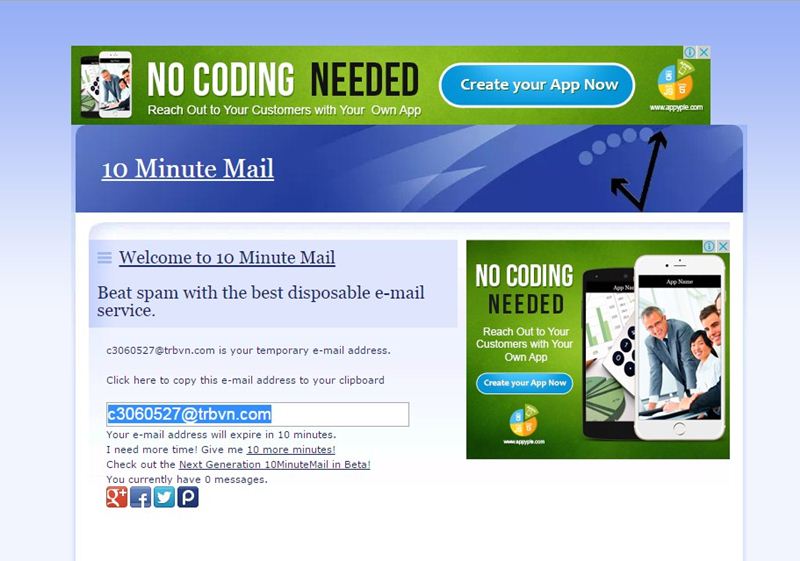
10 Minute Mail
10 Minute Mail will provide you a temporary e-mail address. Any e-mails sent to that address will show automatically on the web page. You can read them, click on links, and even reply to them. The email address will expire after 10 minutes.
#2 GuerrillaMail
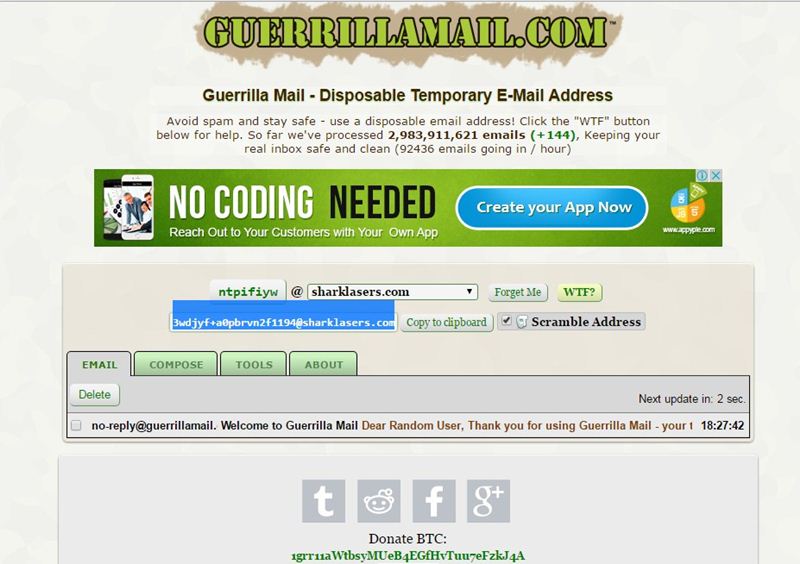
Guerrillamail
It is one of the most user-friendly ones out there, with this, you can get disposable email ID easily. You need to enter the details, and the fake email ID will be generated. Moreover, this also lets you send emails with attachment up to 150MB. You will be provided with a temporary email address which you can use to verify some websites which require the email address.
#3 Mailinator
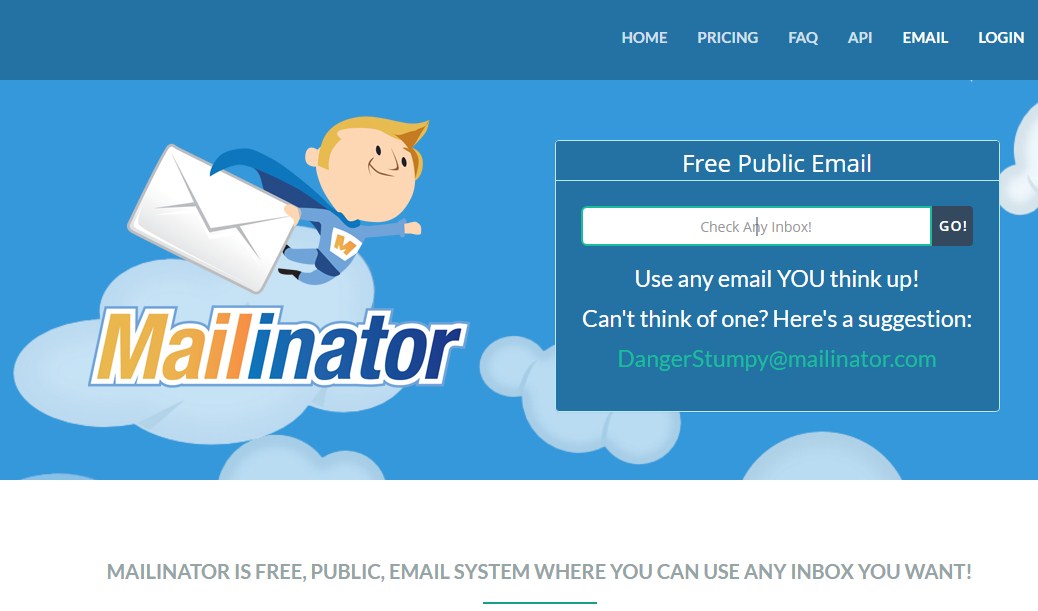
Mailinator
Mailinator is a free, Public, Email System where you can use any inbox you want. You will be given a Mailinator address which you can use anytime a website asks for an email address. The public emails you will receive will be auto-deleted after few hours of receiving.
#4 MailDrop
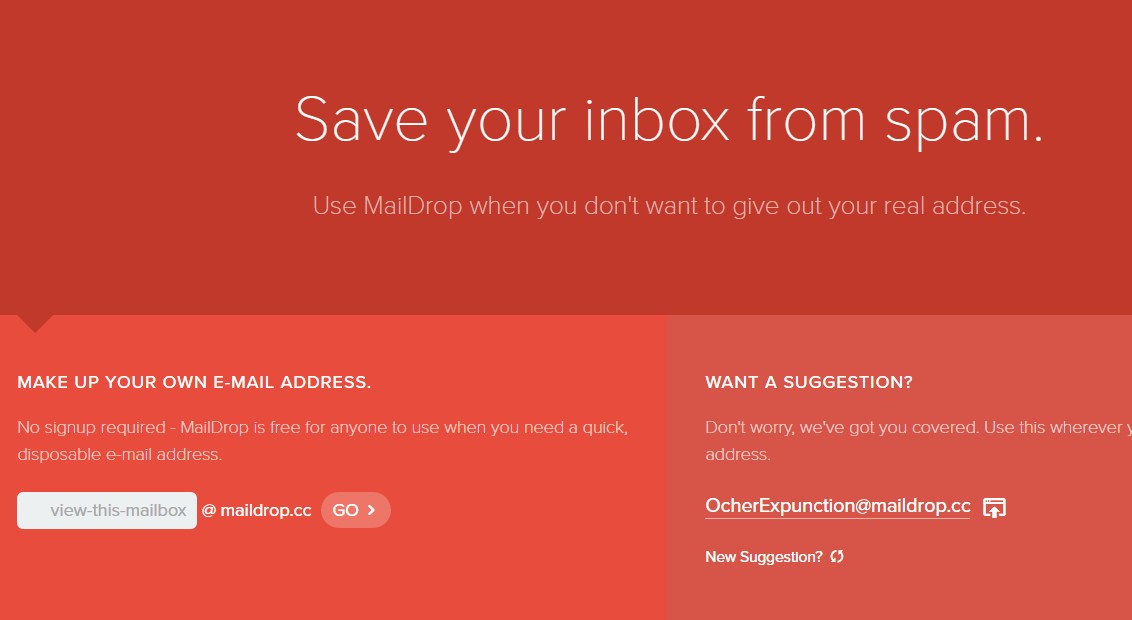
MailDrop
Maildrop is a great idea when you want to sign up for a website but you are concerned that they might share your address with advertisers. MailDrop is powered by some of the spam filters created by Heluna, used in order to block almost all spam attempts before they even get to your MailDrop inbox. This works the same way like Mailinator in which you will be given a temporary Email address which you can use to verify sites etc.
#5 AirMail

AirMail
AirMail is a free temporary email service, you are given a random email address you can use when registering to new websites or test-driving untrusted services. All emails received by AirMail servers are displayed automatically in your online browser inbox.
Related word
- Hacking Tools Download
- Physical Pentest Tools
- Hacker Tools Mac
- Pentest Tools Framework
- Hacker Tools Hardware
- Hacking Tools For Beginners
- How To Hack
- Hacker Tools Windows
- Pentest Tools Linux
- Hacking App
- Hacking Tools Name
- Hack Website Online Tool
- Best Hacking Tools 2020
- Hacking Tools For Kali Linux
- Hacker Techniques Tools And Incident Handling
- Hack Tools For Ubuntu
- Pentest Tools Free
- Ethical Hacker Tools
- Hacker Tools List
- Hacking Tools 2019
- Hacking Tools For Windows Free Download
- Hacking Tools Windows 10
- Tools 4 Hack
- Hacking Tools For Kali Linux
- Physical Pentest Tools
- Blackhat Hacker Tools
- Hacker Tools
- Blackhat Hacker Tools
- Pentest Tools Kali Linux
- Usb Pentest Tools
- Hack Tools For Ubuntu
- Hacking Tools For Games
- Hacker Tools Apk Download
- Pentest Tools Alternative
- Hacker Search Tools
- Pentest Tools Find Subdomains
- Blackhat Hacker Tools
- Hack Tools Github
- Hacker Tools Apk
- Hacking Tools Software
- Pentest Tools Nmap
- Hack Tools Download
- Hacker Tools Linux
- Hack And Tools
- What Is Hacking Tools
- Hacking Tools For Windows Free Download
- Hack Apps
- Pentest Tools For Android
- New Hack Tools
- Android Hack Tools Github
- Pentest Tools Kali Linux
- Hackrf Tools
- Nsa Hacker Tools
- Hacking Tools For Windows
- Hacks And Tools
Suscribirse a:
Entradas (Atom)


